
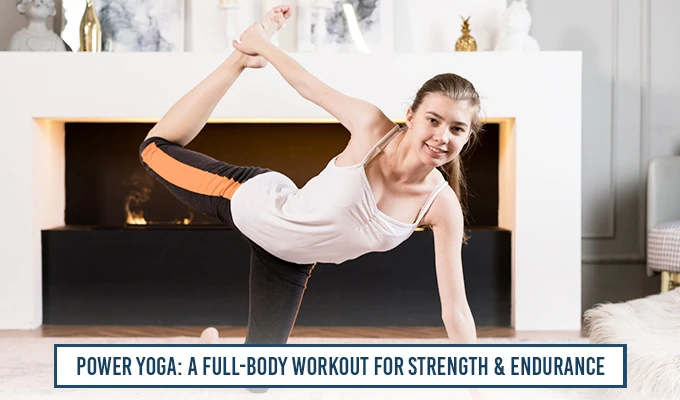
Looking for a strength-focused style of yoga that goes beyond flexibility? Power yoga is a perfect option if you’re looking to improve strength, endurance, and overall fitness. Based on sequences, movement and controlled breathing, power yoga is different when compared to traditional forms of yoga. This blog aims to explain power yoga, the muscles it targets, its associated benefits, and its suitability. Tips on how to develop a full power yoga routine are also mentioned. Continue reading to know more.
Power yoga is based on Ashtanga yoga, but it takes into consideration modern yoga principles. It’s ideal for people who are searching for a dynamic full-body workout. The focus here is not just on improving your flexibility but also your cardio strength. Poses such as planks, chaturangas, and warrior sequences are often a part of power yoga. Most power yoga exercises are aimed at generating internal heat, which helps you move in a meditative state.
Power yoga is aimed at engaging your upper body, core and lower body. Let’s try to understand this in more detail:
Poses such as planks, chaturangas, upward-facing dog and downward-facing dog are aimed at improving your arm strength. The holding and transitioning in these poses help to engage both your upper back and chest. After some time, you’ll surely be able to build some muscle endurance.
Core activation is an essential element of power yoga. Poses such as planks, side planks, boat pose and even standing balances require constant core engagement. If you’re up for a challenge, twisting movements and single-leg poses are some great options. These exercises not only strengthen your muscles but also enable better posture.
Standing poses are a foundation exercise used to build your lower body strength. Poses such as chair pose, lunges and warrior variations help to target the glutes, quadriceps, hamstrings and calves. Over time, these power yoga poses help to improve both your joint control and leg strength.
Power yoga acts as a full-body workout for both your body and mind. This is because it requires a mix of strength, movement and controlled breathing. Here are certain benefits of power yoga one can experience:
Due to the weight-bearing poses, power yoga involves engaging multiple muscles at the same time. Due to this, everyday movements such as lifting, bending and walking become easy. Functional strength helps to enhance joint stability, which reduces the risk of injury.
Unlike regular workouts, power yoga requires you to switch from one pose to the next. Sequences such as sun salutations, lunges, warrior flows, and plank transitions require your body to adapt to the required effort. It’s the controlled breathing technique that plays a vital role in improving your cardiovascular endurance.
Due to the transition between poses such as lunges, forward folds, backbends and twists, you end up stretching multiple muscle groups at the same time. Improved flexibility results in a greater range of motion over time. With regular practice, you can notice your movements becoming smoother.
Power yoga requires the use of controlled breathing along with internal focus. The distractions fade with every movement, allowing the mind to focus on the present. A calm nervous system automatically helps to better regulate stress response. Releasing built-up tension also plays a major role in stress reduction. Meditation is another powerful technique that helps with stress relief. Read our blog on the best meditation techniques for better understanding.
Routines in a power yoga session are aimed at gradually increasing the intensity. Most power yoga sequences are designed to challenge you while ensuring proper cooldown time. Work with a power yoga personal trainer in Mumbai for perfect pacing. Here is a routine you are very likely to notice:
Your session is likely to begin with a warm-up aimed at reducing the risk of any injury. Gentle movements for your neck, shoulders, hips and ankles allow your body to loosen stiffness.
Flow-based sequences usually begin with sun salutations and slowly progress towards lunges, chair pose, and warrior variations. As the session progresses, other poses such as the half moon and an airplane pose can be added to the sequence.
Strength-focused poses such as planks, chaturangas, and warrior holds require you to engage your muscles in the arms, shoulders, core, and legs. Transitions between poses are a vital part that helps you to improve coordination.
Poses such as planks, side planks, and boat pose require control from the abdominal and lower-back muscles. For stability, the use of twists and balance transitions is recommended. In general, a power yoga routine supports total body fitness.
Cooldown and recovery are essential to help your body reach a relaxed state. The use of long stretches and long holds can be used for this purpose. Poses here can include forward folds, gentle twists, and hip openers. Proper cooldown and recovery also help to reduce any post-workout soreness.
Savasana is the end phase of a power yoga session. It focuses on both physical and mental recovery. The aim is to make the body return to its natural state. With your muscles relaxing, your body is able to derive benefits from the entire session. A tip to follow here is never rush the savasana phase in your routine.
Power yoga can benefit a wide range of people, but it is more demanding than traditional yoga. An individual’s fitness level, experience and overall health should be taken into consideration. Here’s a detailed explanation:
Beginners should focus more on the correct alignment, breathing and transitions rather than speed and intensity. Certain modifications, such as knee-supported planks, slow transitions, and reduced pose holds, can be done. Taking required breaks is especially recommended for beginners.
Those with some level of experience often benefit most from power yoga. After a strong foundation, doing advanced variations often becomes easy. It’s important to maintain a proper alignment even at an advanced level.
People with joint issues, back problems, or any injuries or medical conditions need to be extra careful with power yoga. This is because the use of strength-based poses and continuous movement is often incorporated. Consulting a qualified instructor is advisable in these cases. A muscle rehabilitation programme will work wonders for addressing issues such as knee pain, lower back pain, and ankle, neck or shoulder injuries. Check our muscle rehabilitation services for more information.
Power yoga is not just a traditional yoga practice; it is a full-body workout. With all the above-mentioned benefits, power yoga is something you definitely should not skip. By following the sequences mentioned, you’ll easily be able to develop a balanced fitness routine. A fitness trainer can guide you at every step in this fitness journey. With guidance from an experienced trainer, you’ll be able to avoid any injuries well in advance. If you’re interested in developing sustainable fitness and looking for a personal fitness trainer in Mumbai, you can contact Sudam Shelar. With the right guidance from the expert, you’ll surely be able to see results in no time.